Research Article |
 Hao-Tian Wang‡§, Ming-Hong Huang|, Chen-Xi Liao¶, Xian-Chun Qiu§, Han-Ming Song#, Shuo Qi#, Da-Er Ding‡, Shang-Biao Zhuo|, Wei Wang¤, Jun Wu«, Bin Wang», Ying-Yong Wang˄, Pi-Peng Li§, Ji-Chao Wang‡
|
Corresponding author: Ying-Yong Wang ( wangyy@mail.sysu.edu.cn ) Corresponding author: Pi-Peng Li ( lipipeng@yahoo.com ) Corresponding author: Ji-Chao Wang ( wjc@hainnu.edu.cn ) Academic editor: Luis Ceríaco
© 2026 Hao-Tian Wang, Ming-Hong Huang, Chen-Xi Liao, Xian-Chun Qiu, Han-Ming Song, Shuo Qi, Da-Er Ding, Shang-Biao Zhuo, Wei Wang, Jun Wu, Bin Wang, Ying-Yong Wang, Pi-Peng Li, Ji-Chao Wang.
This is an open access article distributed under the terms of the Creative Commons Attribution License (CC BY 4.0), which permits unrestricted use, distribution, and reproduction in any medium, provided the original author and source are credited.
Citation:
Wang H-T, Huang M-H, Liao C-X, Qiu X-C, Song H-M, Qi S, Ding D-E, Zhuo S-B, Wang W, Wu J, Wang B, Wang Y-Y, Li P-P, Wang J-C (2026) A new species of Rana (Amphibia, Anura, Ranidae) from Hainan, Southern China. ZooKeys 1296: 185-208. https://doi.org/10.3897/zookeys.1296.211503
|
 |
Abstract
A new species of the genus Rana is described from Hainan Island, southern China, based on morphological and molecular evidence. During herpetological surveys conducted in Wanning City and Mt. Diaoluo, Hainan Province, a series of Rana specimens assignable to the R. johnsi group were collected from montane tropical rainforest habitats. Phylogenetic analyses based on mitochondrial 16S, COI, and cyt b sequences recovered the Hainan population as a distinct and well-supported lineage within the R. johnsi group. Morphometric analyses, including PCA, DAPC, and PERMANOVA, further demonstrated significant differentiation between the Hainan population and its congeners. The new species, Rana hainan Wang, Qiu, Song, Qi, Wang, Li & Wang, sp. nov., is characterized by a medium body size, head longer than wide, a distinct triangular black patch on the temporal region, straight and narrow dorsolateral folds, toe tips with connected lateroventral grooves, absence of tarsal folds, and breeding males possessing a continuous grayish-white nuptial pad on finger I. Historical records of R. varians, R. nigrotympanica, and R. johnsi from Hainan are reviewed. Records from Mt. Diaoluo are reassigned to the new species, whereas records from other localities are conservatively treated as Rana cf. johnsi pending further investigation.
Key words:
Hainan Island, historical records, integrative taxonomy, molecular phylogeny, Rana johnsi group
Introduction
Rana Linnaeus, 1758, represents a taxonomically complex and widely distributed lineage within the family Ranidae, occurring broadly across temperate regions of the Northern Hemisphere, ranging from temperate Eurasia through Indochina and extending into western North America from Alaska to northern Baja California, Mexico (
In China, Rana sensu lato is currently represented by approximately 30 recognized species (
Previous studies have reported Hainan populations of Rana under different taxonomic names.
During recent field surveys in Wanning City and Mt. Diaoluo, Hainan Province, China, several specimens of Rana were collected. Detailed morphological examination indicates that these specimens belong to the Rana johnsi group of the subgenus Rana, as evidenced by the presence of lateroventral grooves on the flattened tips of the toes and a distinct triangular black patch on the temporal region. The specimens, however, are readily distinguishable from all currently recognized congeners. Phylogenetic analyses further corroborate their distinctiveness, recovering them as an independent evolutionary lineage within the genus. Based on the combined morphological and molecular evidence, we herein describe this population from Wanning and Mt. Diaoluo, Hainan, as a new species of the subgenus Rana.
Materials and methods
Sampling
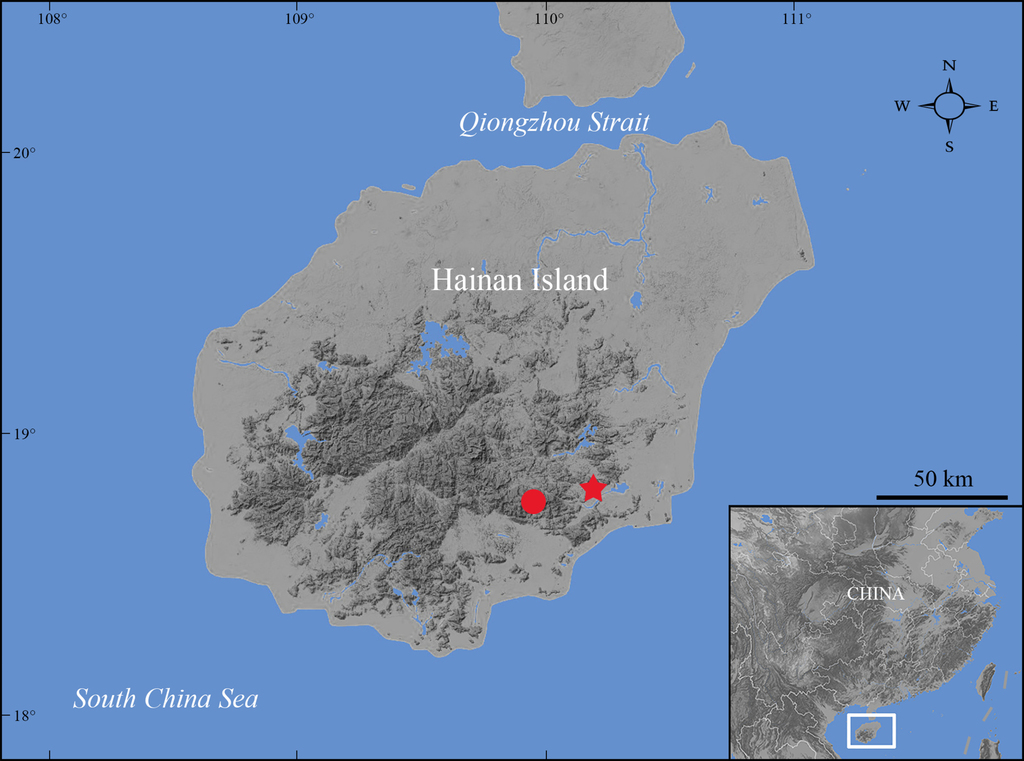
Twelve specimens of the subgenus Rana were collected from Shangxi Provincial Nature Reserve, Wanning City, and Mt. Diaoluo, Lingshui County, Hainan Province, China (Fig.

Morphology
The morphological terminologies and measurements followed
Statistical analyses
Only male specimens were included in the statistical analyses due to the limited availability of females. The dataset comprised three individuals from Hainan, 10 of R. johnsi, 27 of R. sangzhiensis Shen, 1986, and four of R. wuyiensis Wu, Shi, Zhang, Chen, Cai, Hoang, Wu & Wang, 2021.
All morphometric variables were natural log-transformed (ln) to improve normality and reduce heteroscedasticity. To remove allometric effects of body size using the following equation: Xa = Xln – β • (SVLln – SVLm), where Xa = adjusted value; Xln = ln-transformed measurements; β = unstandardized regression coefficient for each species; SVLln = ln-transformed SVL; and SVLm = overall average SVLln of all samples (
Molecular phylogenetic analyses
Genomic DNA was extracted from tissue samples using a DNA extraction kit TIANamp Genomic DNA Kit from Tiangen Biotech (Beijing) Co., Ltd. Three mitochondrial DNA fragments were amplified: the partial 16S ribosomal RNA coding sequence (16S), the partial cytochrome c oxidase subunit 1 gene (COI) and the partial cytochrome b (cyt b) gene. PCR primers and reaction conditions are provided in Table
| Gene | Primer | Sequence | Annealing temperature (°C) | Reference |
|---|---|---|---|---|
| 16S | L3975 | 5'-CGCCTGTTTACCAAAAACAT-3' | 51 | |
| H4551 | 5'-CCGGTCTGAACTCAGATCACGT-3' | |||
| L2A | 5'-CCAAACGAGCCTAGTGATAGCTGGTT-3' | |||
| H10 | 5'-TGATTACGCTACCTTTGCACGGT-3' | |||
| COI | dgLCO | 5'-GGTCAACAAATCATAAAGAYATYGG-3' | 45 | |
| dgHCO | 5'-AAACTTCAGGGTGACCAAARAAYCA-3' | |||
| cyt b | HERP328 | 5'-GAAAARCTRTCGTTGTWATTCAACTA-3' | 52 | |
| HERP329 | 5'-CTACKGGTTGTCCYCCRATTCATGT-3' | 53 |
Localities, voucher information, and GenBank accession numbers for all samples used in this study. “/” unavailable data.
| No. | Species | Voucher ID | Locality | 16S | COI | cyt b |
|---|---|---|---|---|---|---|
| 1 | Rana hainan sp. nov. |
|
China: Hainan: Wanning: Shangxi Nature Reserve | QB070440 | QB070455 | QB074718 |
| 2 | Rana hainan sp. nov. |
|
China: Hainan: Wanning: Shangxi Nature Reserve | QB070441 | QB070456 | QB074719 |
| 3 | Rana hainan sp. nov. |
|
China: Hainan: Wanning: Shangxi Nature Reserve | QB070442 | QB070457 | QB074720 |
| 4 | Rana hainan sp. nov. |
|
China: Hainan: Mt. Diaoluo | QB070443 | QB070458 | QB074721 |
| 5 | Rana hainan sp. nov. | HNU 260407 | China: Hainan: Mt. Diaoluo | QB070444 | QB070459 | QB074722 |
| 6 | Rana hainan sp. nov. | HNU 260408 | China: Hainan: Mt. Diaoluo | QB070445 | QB070460 | QB074723 |
| 7 | Rana hainan sp. nov. | HNU 260409 | China: Hainan: Mt. Diaoluo | QB070446 | QB070461 | QB074724 |
| 8 | Rana hainan sp. nov. | HNU 260411 | China: Hainan: Wanning: Shangxi Nature Reserve | QB070447 | QB070462 | QB074725 |
| 9 | Rana hainan sp. nov. | HNU 260412 | China: Hainan: Wanning: Shangxi Nature Reserve | QB070448 | QB070463 | QB074726 |
| 10 | Rana hainan sp. nov. | HNU 260413 | China: Hainan: Wanning: Shangxi Nature Reserve | QB070449 | QB070464 | QB074727 |
| 11 | Rana hainan sp. nov. | HNU 260414 | China: Hainan: Wanning: Shangxi Nature Reserve | QB070450 | QB070465 | QB074728 |
| 12 | Rana wuyiensis | LSU202109001WYS01 | China: Fujian: Wuyi Mountain | OL467321 | OL467321 | OL467321 |
| 13 | Rana wuyiensis | CIB WY20201106016 | China: Fujian: Wuyi Mountain | MZ337980 | / | MZ355497 |
| 14 | Rana wuyiensis | CIB WY20201106018 | China: Fujian: Wuyi Mountain | MZ337981 | / | MZ355498 |
| 15 | Rana wuyiensis | CIB WY20201106007 | China: Fujian: Wuyi Mountain | MZ337982 | / | MZ355499 |
| 16 | Rana wuyiensis | CIB WY20201106005 | China: Fujian: Wuyi Mountain | MZ337983 | / | MZ355500 |
| 17 | Rana wuyiensis | CIB WY20200913003 | China: Fujian: Wuyi Mountain | MZ337984 | / | MZ355501 |
| 18 | Rana wuyiensis | CIB WY20200913001 | China: Fujian: Wuyi Mountain | MZ337985 | / | MZ355502 |
| 19 | Rana wuyiensis | CIB WY20201106017 | China: Fujian: Wuyi Mountain | MZ337986 | / | MZ355503 |
| 20 | Rana wuyiensis | CIB WY20201106006 | China: Fujian: Wuyi Mountain | MZ337987 | / | MZ355504 |
| 21 | Rana wuyiensis | CIB WY20200913002 | China: Fujian: Wuyi Mountain | MZ337988 | / | MZ355505 |
| 22 | Rana wuyiensis | CIB WYS20200829003 | China: Fujian: Wuyi Mountain | MZ337989 | / | MZ355506 |
| 23 | Rana wuyiensis | CIB WYS20200829002 | China: Fujian: Wuyi Mountain | MZ337990 | / | MZ355507 |
| 24 | Rana wuyiensis | CIB WYS20200829001 | China: Fujian: Wuyi Mountain | MZ337991 | / | MZ355508 |
| 25 | Rana sangzhiensis | CIB GL150097 | China: Sichuan: Gulin | MZ337992 | / | MZ355509 |
| 26 | Rana sangzhiensis | CIB GL150091 | China: Sichuan: Gulin | MZ337993 | / | MZ355510 |
| 27 | Rana sangzhiensis | CIB GL150088 | China: Sichuan: Gulin | MZ337994 | / | MZ355511 |
| 28 | Rana sangzhiensis | CIB GL150011 | China: Sichuan: Gulin | MZ337995 | / | MZ355512 |
| 29 | Rana sangzhiensis | CIB GL150010 | China: Sichuan: Gulin | MZ337996 | / | MZ355513 |
| 30 | Rana sangzhiensis | CIB GL150068 | China: Sichuan: Gulin | MZ337997 | / | MZ355514 |
| 31 | Rana sangzhiensis |
|
China: Hunan: Sangzhi: Tianping Mountain | MT408972 | MT418634 | / |
| 32 | Rana sangzhiensis | CIB SZ2012062103 | China: Hunan: Sangzhi: Tianping Mountain | MZ337998 | / | / |
| 33 | Rana sangzhiensis | CIB SZ2012062106 | China: Hunan: Sangzhi: Tianping Mountain | MZ337999 | / | / |
| 34 | Rana sangzhiensis | CIB SZ2012062104 | China: Hunan: Sangzhi: Tianping Mountain | MZ338000 | / | MZ355515 |
| 35 | Rana sangzhiensis | CIB TPS20190413-FTY1-5 | China: Hunan: Sangzhi: Tianping Mountain | MZ338001 | / | MZ355516 |
| 36 | Rana sangzhiensis | CIB TP20190413-36 | China: Hunan: Sangzhi: Tianping Mountain | MZ338002 | / | MZ355517 |
| 37 | Rana sangzhiensis | CIB TPS20190413-FTY1-1 | China: Hunan: Sangzhi: Tianping Mountain | MZ338003 | / | MZ355518 |
| 38 | Rana sangzhiensis | CIB TPS20190413-FTY1-2 | China: Hunan: Sangzhi: Tianping Mountain | MZ338004 | / | MZ355519 |
| 39 | Rana sangzhiensis | CIB TPS20190413-FTY1-3 | China: Hunan: Sangzhi: Tianping Mountain | MZ338005 | / | MZ355520 |
| 40 | Rana sangzhiensis | CIB TPS20190413-FTY1-4 | China: Hunan: Sangzhi: Tianping Mountain | MZ338006 | / | MZ355521 |
| 41 | Rana sangzhiensis | SCUM 0405190CJ | China: Sichuan: Hongya: Zhangcun | KX269206 | MF149929 | KX269352 |
| 42 | Rana sangzhiensis | CIB SZ2012062102 | China: Hunan: Sangzhi: Tianping Mountain | MZ338007 | / | MZ355522 |
| 43 | Rana johnsi | ABV-00203 | Vietnam: Lam Dong: Loc Bao | KX269182 | / | KX269328 |
| 44 | Rana johnsi | NNU 1910030 | China: Guangxi: Shiwandashan Mountains | MZ338008 | / | MZ355523 |
| 45 | Rana johnsi | NNU 1910023 | China: Guangxi: Shiwandashan Mountains | MZ338009 | / | MZ355524 |
| 46 | Rana johnsi | NNU 1910010 | China: Guangxi: Shiwandashan Mountains | MZ338010 | / | MZ355525 |
| 47 | Rana johnsi | NNU 1910032 | China: Guangxi: Shiwandashan Mountains | MZ338011 | / | MZ355526 |
| 48 | Rana johnsi | NNU 1910009 | China: Guangxi: Shiwandashan Mountains | MZ338012 | / | MZ355527 |
| 49 | Rana johnsi | NNU 1910001 | China: Guangxi: Shiwandashan Mountains | MZ338013 | / | MZ355528 |
| 50 | Rana johnsi | NNU 1910035 | China: Guangxi: Shiwandashan Mountains | MZ338014 | / | MZ355529 |
| 51 | Rana johnsi | NNU 1910021 | China: Guangxi: Shiwandashan Mountains | MZ338015 | / | MZ355530 |
| 52 | Rana johnsi | NNU 1910017 | China: Guangxi: Shiwandashan Mountains | MZ338016 | / | MZ355531 |
| 53 | Rana johnsi | NNU 1910002 | China: Guangxi: Shiwandashan Mountains | MZ338017 | / | MZ355532 |
| 54 | Rana johnsi | GXJX20180723-1 | China: Guangxi: Jinxiu | MZ571365 | MZ571365 | MZ571365 |
| 55 | Rana johnsi | CIB 20070712-1 | China: Guangxi: Jinxiu | MZ338018 | / | MZ355533 |
| 56 | Rana johnsi | CIB 20070712 | China: Guangxi: Jinxiu | MZ338019 | / | MZ355534 |
| 57 | Rana johnsi | IEBR.A 4849 | Vietnam: Cao Bang | MZ338020 | / | MZ355535 |
| 58 | Rana johnsi | IEBR.A 4848 | Vietnam: Cao Bang | MZ338021 | / | MZ355536 |
| 59 | Rana johnsi | CIB 201204008 | Vietnam: Cao Bang | MZ338022 | / | MZ355537 |
| 60 | Rana amurensis | MSUZP-SLK-RUS49 | Russia: Tomskaya: Teguldetskii | KX269203 | / | KX269349 |
| 61 | Rana arvalis | MSUZP-SLK-MKR21 | Russia: Mordovia: Chamzinskii | KX269197 | / | KX269344 |
| 62 | Rana asiatica | KIZ-XJ0251 | China: Xinjiang: 47tuan | KX269200 | PQ434917 | KX269346 |
| 63 | Rana chaochiaoensis | SCUM 0405170CJ | China: Sichuan: Zhaojue | KX269192 | / | KX269339 |
| 64 | Rana chensinensis | KIZ RD05SHX01 | China: Shaanxi: Huxian | KX269186 | JF939080 | KX269333 |
| 65 | Rana coreana | MMS 223 | South Korea | KX269202 | MF149928 | KX269348 |
| 66 | Rana culaiensis | KIZ SD080501 | China: Shandong: Culai Mountain | KX269190 | JF939082 | KX269337 |
| 67 | Rana dabieshanensis | AHU 2016R001 | China: Anhui: Dabie Mountains | MF172963 | / | MF172964 |
| 68 | Rana dalmatina | MSUZP-NPUA-R-21-1 | Ukraine: Zakarpatska: Uzhgorod | KX269198 | / | / |
| 69 | Rana dybowskii | MSUZP-IVM-1d | Russia: Primorye: Khasanskii | KX269188 | / | KX269335 |
| 70 | Rana graeca | ZMMU A-4293-1 | Crna Gora (Montenegro): Niksic environs | KX269199 | / | KX269345 |
| 71 | Rana hanluica | KIZ GX07112915 | China: Guangxi: Maoer Mountain | KX269191 | / | KX269338 |
| 72 | Rana huanrensis | SYNU 040006 | China: Liaoning: Huanren | / | JF939072 | JN984545 |
| 73 | Rana iberica | ZMMU A-4292-1 | Portugal: Porto: Valongo environs | KX269195 | / | KX269342 |
| 74 | Rana japonica | KIZ-YPX11775 | Japan: Isumi-shi: Chiba Prefecture | KX269220 | JF939101 | KX269364 |
| 75 | Rana jiemuxiensis | KIZ 05263 | China: Hunan: Jiemuxi | / | JF939090 | JF939127 |
| 76 | Rana jiulingensis |
|
China: Jiangxi: Guanshan | MT408985 | MT418647 | / |
| 77 | Rana kobai | KUHE: 10051 | Japan: Amami | AB685778 | / | / |
| 78 | Rana kukunoris | KIZ CJ06102001 | China: Qinghai: Qinghai Lake | KX269185 | JF939073 | KX269332 |
| 79 | Rana latastei | Veith 2003 | Italy: Campagna: Seseglio 2 km | AY147946 | / | AY147967 |
| 80 | Rana longicrus | NMNS 15022 | China: Taiwan: Miaoli: Xiangtianhu | KX269189 | / | KX269336 |
| 81 | Rana luanchuanensis | KIZ047393 | China: Henan: Luanchuan | / | MF149920 | / |
| 82 | Rana macrocnemis | MSUZP-LFM-12 | Russia: Daghestan: Agulskiy | KX269194 | / | KX269341 |
| 83 | Rana maoershanensis | SYNU 08030061 | China: Guangxi: Mt Maoershan | KX139722 | KX139728 | KX139731 |
| 84 | Rana minuscula | SWU 0012282 | China: Zhejiang: Lishui | PQ350269 | / | / |
| 85 | Rana omeimontis | SCUM 0405196CJ | China: Sichuan: Hongya | KX269193 | / | KX269340 |
| 86 | Rana ornativentris | KIZ-JP080101 | Japan: Kyoto | KX269187 | / | KX269334 |
| 87 | Rana pirica | MSUZP-NPFE-R-08-42 | Russia: Sakhalinskaya: Makorovskiy | KX269184 | / | KX269331 |
| 88 | Rana pyrenaica | ZFMK 65447-65448 | Spain: Zuriza: Aragón | AY147950 | / | AY147971 |
| 89 | Rana qui | HNNU2302I026 | China: Henan: Nanzhao | PQ881622 | / | / |
| 90 | Rana sakuraii | KIZJP080104 | Japan: Tokyo | KX269205 | / | KX269351 |
| 91 | Rana sauteri | SCUM 0405175CJ | China: Taiwan: Kaohsiung | KX269204 | / | KX269350 |
| 92 | Rana shuchinae | CIB HUI040009 | China: Sichuan: Zhaojue | KX269210 | / | KX269356 |
| 93 | Rana tagoi | MSUZP-NPJP-R-08-69 | Japan: Kyoto | KX269214 | / | KX269359 |
| 94 | Rana taihangensis | HNNU202008II001 | China: Henan: Huixian | ON737935 | ON738019 | ON738116 |
| 95 | Rana temporaria | ZMMU A-4288-1 | Ukraine: Zakarpatska: Uzhgorod | KX269196 | / | KX269343 |
| 96 | Rana tsushimensis | NAP 4191 | Japan: Nagasaki: Tsushima | KX269181 | / | KX269329 |
| 97 | Rana ulma | OKW 135 | Japan: Ryukyu Islands | KX269215 | / | KX269360 |
| 98 | Rana zhijinensis | GZNU2018081606 | China: Guizhou: Zhijin | OP577495 | / | OP589319 |
| 99 | Rana zhenhaiensis | KIZ 0803271 | China: Zhejiang: Zhenhai | KX269218 | JF939065 | JF939105 |
For phylogenetic analysis, a total of 177 additional sequences were downloaded from GenBank (Table
Results
Morphological analyses
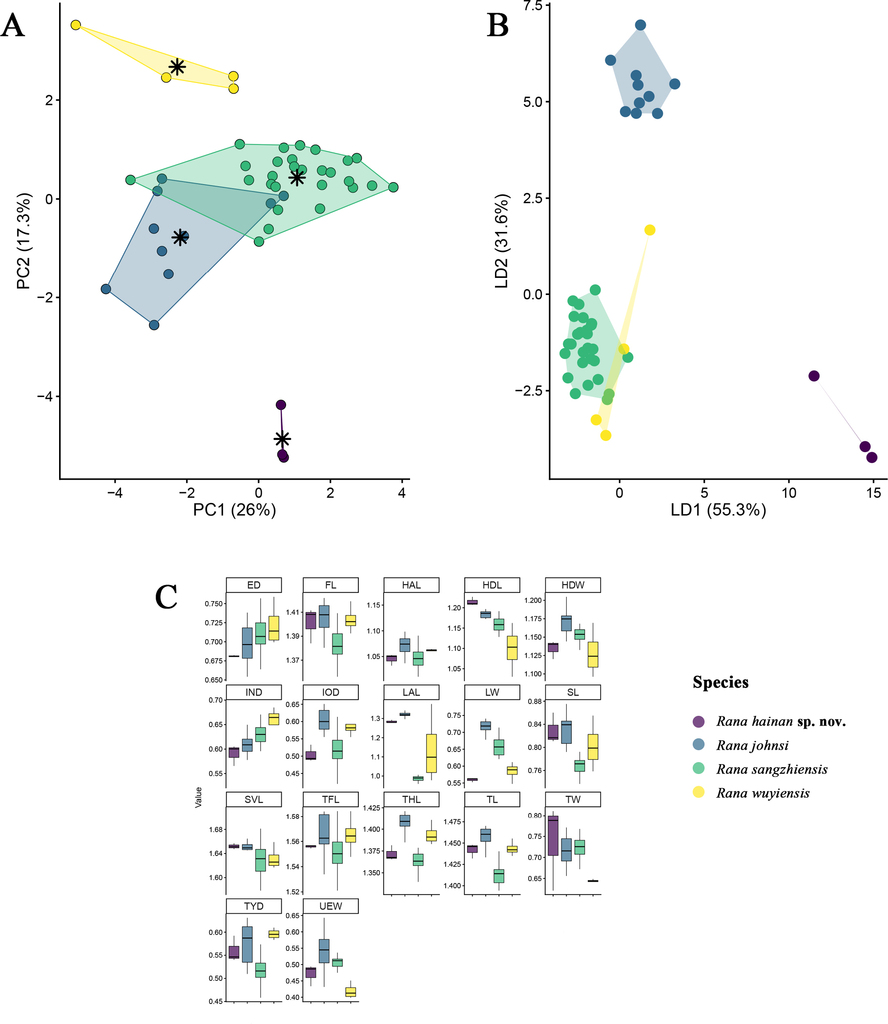
Univariate comparisons of size-adjusted morphometric variables revealed significant differences among the four taxa, with the Hainan population clearly distinguishable from Rana johnsi, R. sangzhiensis, and R. wuyiensis. As shown in Table
Results of the univariate comparisons of the size-corrected morphometric data. Significant differences (p < 0.05) are in bold. Abbreviations are in the Materials and methods.
| Species pairs | SVL | HDL | HDW | SL | IND | IOD | UEW | ED | TYD | LAL | HAL | LW | THL | TL | TW | TFL | FL |
|---|---|---|---|---|---|---|---|---|---|---|---|---|---|---|---|---|---|
| hainan sp. nov. vs johnsi | 1.0000 | 0.2816 | 0.5989 | 0.0019 | 0.1104 | 0.0004 | 0.0146 | 0.1139 | 0.5460 | 1.0000 | 1.0000 | 0.0149 | 0.0046 | 1.0000 | 0.0063 | 0.8639 | 0.9282 |
| hainan sp. nov. vs sangzhiensis | 0.5303 | 0.0355 | 0.7211 | 0.0000 | 1.0000 | 0.1552 | 0.0722 | 0.0026 | 0.9549 | 0.1311 | 0.3447 | 0.7144 | 0.3264 | 1.0000 | 0.1558 | 0.6186 | 0.6786 |
| hainan sp. nov. vs wuyiensis | 1.0000 | 0.0006 | 0.9278 | 0.0002 | 1.0000 | 0.0015 | 1.0000 | 0.0050 | 0.0153 | 1.0000 | 1.0000 | 0.0750 | 0.0025 | 1.0000 | 0.0005 | 0.1582 | 0.7865 |
| johnsi vs sangzhiensis | 0.1706 | 1.0000 | 0.9592 | 0.0000 | 0.0567 | 0.0006 | 1.0000 | 0.1516 | 0.0129 | 0.0000 | 0.9216 | 0.0020 | 0.0291 | 0.0009 | 0.1825 | 0.9249 | 0.8726 |
| johnsi vs wuyiensis | 1.0000 | 0.0286 | 0.1459 | 0.3984 | 0.0102 | 0.9947 | 0.0036 | 0.1884 | 0.0611 | 1.0000 | 1.0000 | 0.0000 | 1.0000 | 1.0000 | 0.8756 | 0.2457 | 0.2503 |
| sangzhiensis vs wuyiensis | 1.0000 | 0.0903 | 0.1820 | 0.0456 | 0.5667 | 0.0126 | 0.0215 | 0.8691 | 0.0001 | 0.0496 | 0.4246 | 0.0001 | 0.0270 | 0.0125 | 0.0116 | 0.3548 | 0.0593 |
Principal Component Analysis (PCA) of the size-adjusted and standardized dataset summarized the overall morphological variation among the four taxa. The first two principal components accounted for 43.3% of the total variance (PC1 = 26.0%, PC2 = 17.3%). In the PCA plot (Fig.
Summary statistics and principal component analysis scores for the Rana johnsi group. Abbreviations are listed in the Materials and methods.
| PC1 | PC2 | PC3 | PC4 | PC5 | PC6 | PC7 | PC8 | PC9 | PC10 | PC11 | PC12 | PC13 | PC14 | PC15 | PC16 | PC17 | |
|---|---|---|---|---|---|---|---|---|---|---|---|---|---|---|---|---|---|
| SVL | -0.0872 | -0.1904 | -0.0453 | -0.1789 | 0.0249 | 0.8603 | -0.4026 | 0.0481 | -0.0509 | 0.1181 | 0.0052 | 0.0012 | -0.0054 | 0.0098 | 0.0058 | 0.0159 | -0.0024 |
| HDL | 0.079 | -0.4423 | 0.1313 | 0.0347 | -0.2427 | -0.0201 | 0.0447 | -0.5237 | -0.4099 | -0.1177 | 0.1935 | -0.2035 | 0.155 | -0.0513 | -0.2242 | -0.2658 | -0.189 |
| HDW | -0.1332 | -0.0877 | 0.5199 | 0.0907 | 0.2511 | -0.0291 | -0.0087 | 0.0179 | 0.3207 | 0.3587 | 0.2978 | 0.0832 | -0.2935 | -0.1307 | -0.3582 | -0.0431 | -0.2669 |
| SL | -0.2884 | -0.3735 | -0.1302 | 0.0828 | 0.2084 | 0.0111 | 0.2129 | -0.077 | 0.1178 | -0.1663 | -0.0307 | -0.1067 | 0.0787 | 0.4316 | -0.1125 | 0.6088 | -0.1708 |
| IND | 0.0322 | 0.0542 | 0.0436 | 0.4909 | 0.5368 | 0.1522 | 0.161 | 0.3059 | -0.3312 | -0.0281 | 0.0072 | -0.3791 | 0.1398 | -0.0159 | 0.0098 | -0.2134 | 0.051 |
| IOD | -0.3197 | 0.1951 | -0.1117 | -0.2511 | -0.0862 | 0.0161 | 0.1932 | 0.2683 | -0.4283 | -0.1094 | 0.5889 | 0.1362 | -0.0608 | -0.1217 | -0.2025 | 0.1737 | 0.1295 |
| UEW | -0.0761 | -0.0176 | 0.5585 | -0.108 | -0.0997 | -0.031 | -0.1527 | 0.1459 | -0.1702 | -0.4436 | -0.3665 | -0.2208 | -0.2258 | -0.2362 | -0.0615 | 0.2739 | 0.1431 |
| ED | -0.0066 | 0.3554 | 0.3055 | 0.206 | 0.2124 | 0.2066 | 0.017 | -0.4794 | 0.0154 | -0.3324 | 0.2175 | 0.3696 | 0.129 | 0.0484 | 0.307 | 0.1057 | 0.0314 |
| TYD | -0.2822 | 0.0746 | -0.22 | -0.0926 | 0.4086 | -0.1839 | -0.2311 | -0.3566 | -0.3625 | 0.154 | -0.3167 | 0.1801 | -0.3705 | 0.0583 | -0.1594 | -0.0832 | 0.1249 |
| LAL | -0.3405 | -0.1987 | -0.1094 | -0.2232 | 0.1626 | 0.0543 | 0.1972 | 0.0382 | 0.3658 | -0.5027 | 0.0289 | -0.0149 | -0.154 | -0.0218 | 0.0639 | -0.5416 | 0.0627 |
| HAL | -0.2451 | -0.2025 | 0.0305 | 0.1383 | 0.045 | -0.3699 | -0.7071 | 0.1616 | 0.0241 | -0.0802 | 0.2949 | -0.0109 | 0.2424 | 0.0791 | 0.2234 | -0.0366 | 0.0595 |
| LW | -0.1634 | -0.2034 | 0.4294 | -0.2599 | -0.0026 | -0.0395 | 0.2499 | 0.1974 | -0.2516 | 0.2732 | -0.1916 | 0.3091 | 0.2446 | 0.3647 | 0.2711 | -0.1885 | 0.0698 |
| THL | -0.3747 | 0.2522 | 0.095 | -0.0309 | -0.0863 | 0.0389 | 0.0245 | -0.226 | 0.2327 | 0.1903 | -0.0952 | -0.2767 | 0.4746 | -0.0241 | -0.3322 | -0.0293 | 0.4608 |
| TL | -0.434 | -0.0535 | -0.0636 | 0.033 | -0.0604 | -0.0022 | 0.1697 | -0.1448 | -0.0287 | 0.2681 | -0.0433 | -0.2147 | -0.0318 | -0.5069 | 0.5535 | 0.1296 | -0.2201 |
| TW | 0.0839 | -0.4699 | -0.0401 | 0.3606 | -0.0702 | 0.0368 | 0.1382 | -0.0183 | 0.0537 | 0.0861 | 0.0645 | 0.2846 | -0.1773 | -0.2199 | 0.0406 | 0.1025 | 0.6538 |
| TFL | -0.2499 | 0.194 | 0.0627 | 0.3641 | -0.4548 | 0.0922 | -0.0037 | -0.0193 | -0.0303 | 0.0622 | 0.0729 | -0.2155 | -0.4618 | 0.4892 | 0.1227 | -0.1427 | 0.0557 |
| FL | -0.3091 | 0.0314 | -0.0975 | 0.4288 | -0.2551 | 0.0705 | -0.0207 | 0.1845 | -0.0493 | -0.138 | -0.3151 | 0.4628 | 0.2054 | -0.1798 | -0.2885 | -0.0954 | -0.3222 |
| Eigenvalue | 4.4176 | 2.9443 | 2.3536 | 1.7461 | 1.297 | 0.8967 | 0.7787 | 0.5616 | 0.4579 | 0.4091 | 0.3308 | 0.2556 | 0.2022 | 0.1465 | 0.0831 | 0.0616 | 0.0576 |
| Proportion of Variance | 0.2599 | 0.1732 | 0.1384 | 0.1027 | 0.0763 | 0.0528 | 0.0458 | 0.033 | 0.0269 | 0.0241 | 0.0195 | 0.015 | 0.0119 | 0.0086 | 0.0049 | 0.0036 | 0.0034 |
| Cumulative Proportion | 0.2599 | 0.433 | 0.5715 | 0.6742 | 0.7505 | 0.8033 | 0.8491 | 0.8821 | 0.909 | 0.9331 | 0.9526 | 0.9676 | 0.9795 | 0.9881 | 0.993 | 0.9966 | 1 |
Discriminant Analysis of Principal Components (DAPC) further confirmed clear morphological separation among the four taxa. Individuals of the Hainan population formed a completely isolated cluster with no overlap with other taxa, highlighting its distinct morphological identity. Convex hulls surrounding each group illustrate well-defined, species-specific clustering, supporting the recognition of the Hainan population as a morphologically independent entity (Fig.
Permutational multivariate analysis of variance (PERMANOVA) revealed significant morphological differentiation for most pairwise comparisons (Table
Results of the PERANOVA of the PCA. Significant differences are in bold.
| Species pairs | F_Model | R2 | p_value | p_adjusted |
| hainan sp. nov. vs johnsi | 7.9710 | 0.4202 | 0.0051 | 0.0306 |
| hainan sp. nov. vs sangzhiensis | 11.3366 | 0.2882 | 0.0001 | 0.0006 |
| hainan sp. nov. vs wuyiensis | 11.7868 | 0.7021 | 0.0286 | 0.1714 |
| johnsi vs sangzhiensis | 10.7490 | 0.2350 | 0.0001 | 0.0006 |
| johnsi vs wuyiensis | 6.2730 | 0.3433 | 0.0010 | 0.0060 |
| sangzhiensis vs wuyiensis | 10.3138 | 0.2623 | 0.0001 | 0.0006 |
Collectively, these results indicate that the Hainan population is morphologically distinct from most of its congeners.
Phylogenetic analyses
The BI and ML analyses produced identical topologies, which are summarized in Fig.
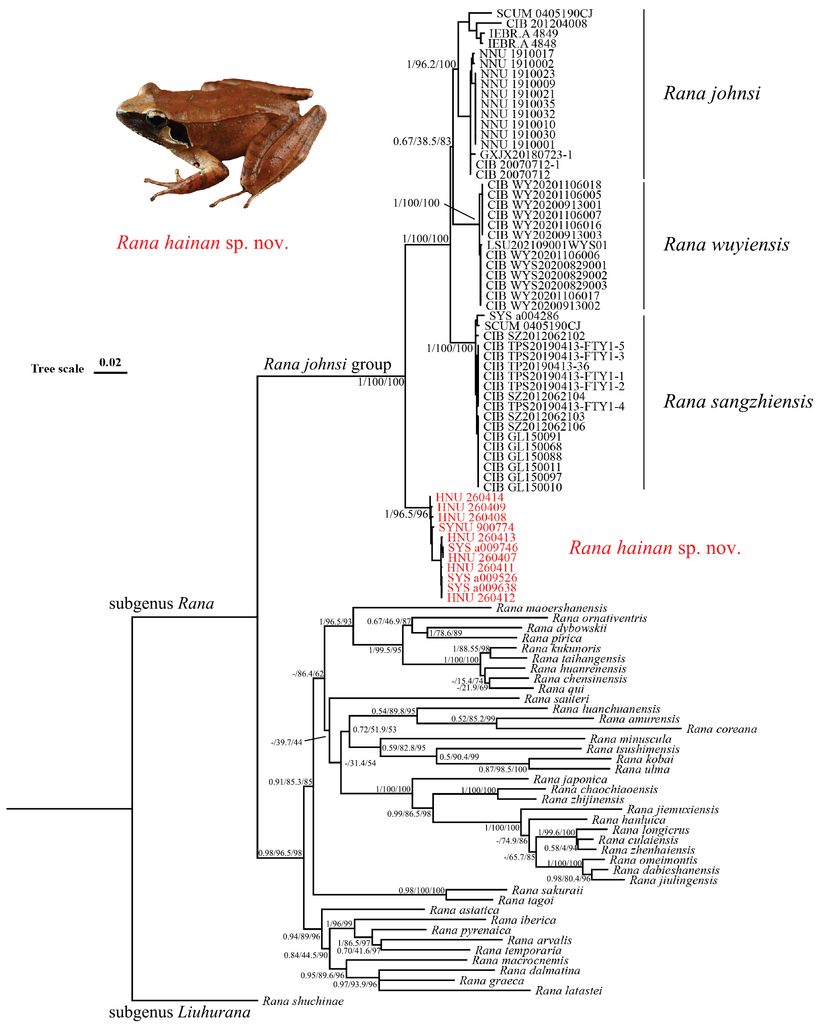
Phylogenetic analyses recovered a strongly supported monophyletic clade comprising all samples of the Rana johnsi group (BPP = 1.00; SH-aLRT = 100; UFB = 100). Within this clade, well-supported lineages corresponding to R. johnsi, R. wuyiensis, R. sangzhiensis, and the Hainan population were resolved. Importantly, the Hainan population forms a distinct, strongly supported lineage (BPP = 1.00; SH-aLRT = 96.5; UFB = 96) that is sister to the clade containing R. johnsi, R. wuyiensis, and R. sangzhiensis. The Hainan lineage exhibits pronounced genetic divergence from all recognized congeners used in this study (Kimura 2-parameter distances: 16S 1.50–10.85%, COI 5.90–20.09%, cyt b 7.37–21.29%), consistent with its distinct evolutionary lineage.
Based on its phylogenetic position, high genetic divergence, and morphological distinctiveness (see Morphological analyses above), we consider them to be all separate species and describe the specimens from Wanning and Mt. Diaoluo, Hainan as a new species.
Taxonomic account
Rana hainan , sp. nov.
Chresonymy. Rana nigrotympanica –
Rana johnsi –
Type material.
Holotype: China • 1 ♂; Hainan Province, Wanning City, Sangengluo Town, Shangxi Provincial Nature Reserve, 18.795246°N, 110.162373°E; altitude 350 m a.s.l.; collected by MHH on 16 January 2026; HNU 260411. Paratypes (n=11): China • 2 ♂; same locality as holotype; collected by MHH on 09 October 2025 and 12 April 2026;
Diagnosis.
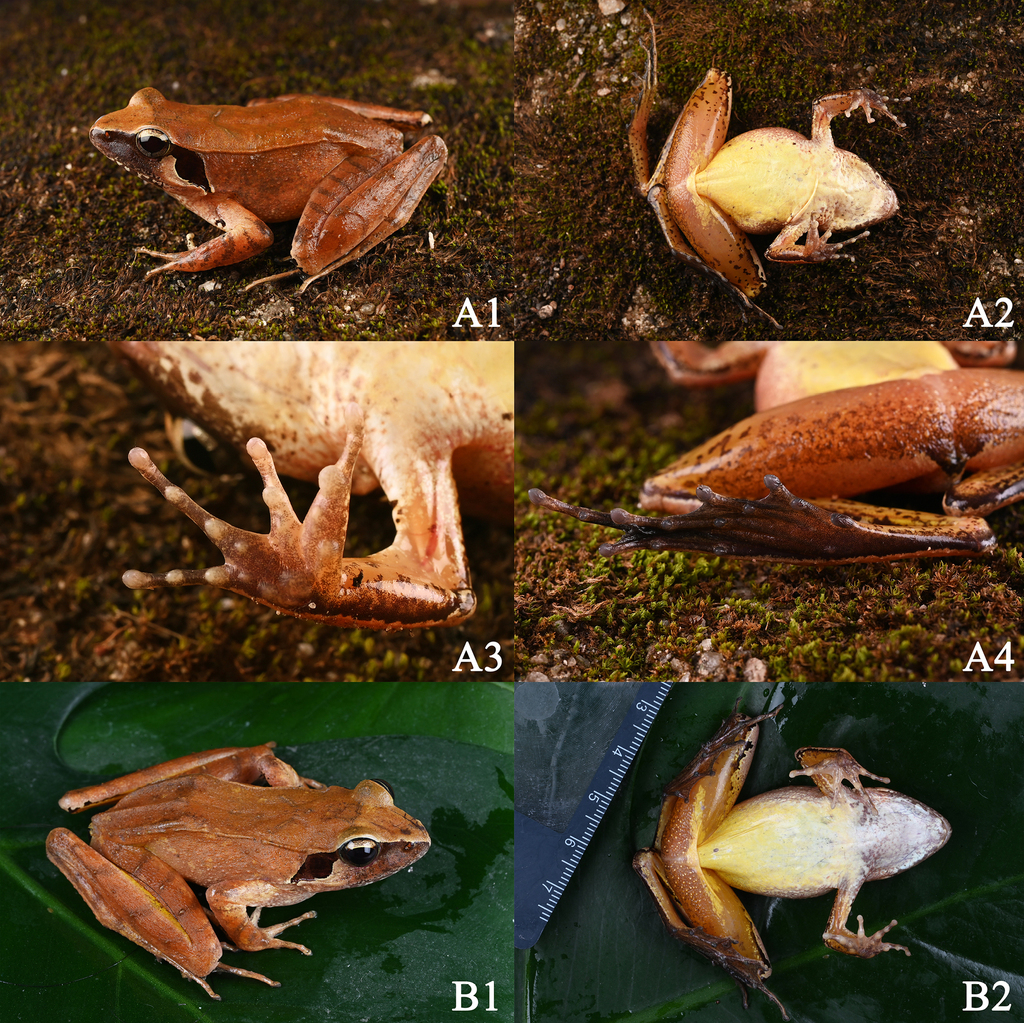
Rana hainan sp. nov. is distinguished by the following morphological characteristics: (1) body medium-sized, SVL 44.4–45.4 (44.9 ± 0.5, n = 3) mm in adult males, 45.4–57.5 (51.2 ± 4.2, n = 9) mm in adult females; (2) head length significantly larger than head width; (3) a distinct triangular black patch on the temporal region; (4) dorsolateral fold distinct and thin, extending straight from posterior margin of upper eyelid to above groin; (5) internarial distances larger than interorbital distances; (6) eyes relatively small; (7) tympanum diameter significantly smaller than eye diameter; (8) fingers without lateroventral grooves, unwebbed, relative finger lengths II < I < IV < III; (9) presence of supernumerary tubercles below the bases of each finger, presence of three separated metacarpal tubercles; (10) toe tips slightly expanded into small discs, lateroventral grooves present on all toe tips, connected at the anterior margin, toes webbing formula: I 0–1/2 II 0–1/2 III 1- – 1/2 IV 1- – 0 V, relative toe lengths I < II < III < V < IV; (11) tibio-tarsal articulation reaching forward beyond tip of snout; (12) heels overlapping; (13) dorsal skin smooth, flanks smooth with few granules; (14) presence of vocal sacs in males; (15) breeding males possessing a grayish-white nuptial pad forming a continuous patch on finger I, extending from the tip of the finger to the posterior margin of the inner metacarpal tubercle, and densely covered with tiny hoary nuptial spines.
Description of the holotype
(Fig.
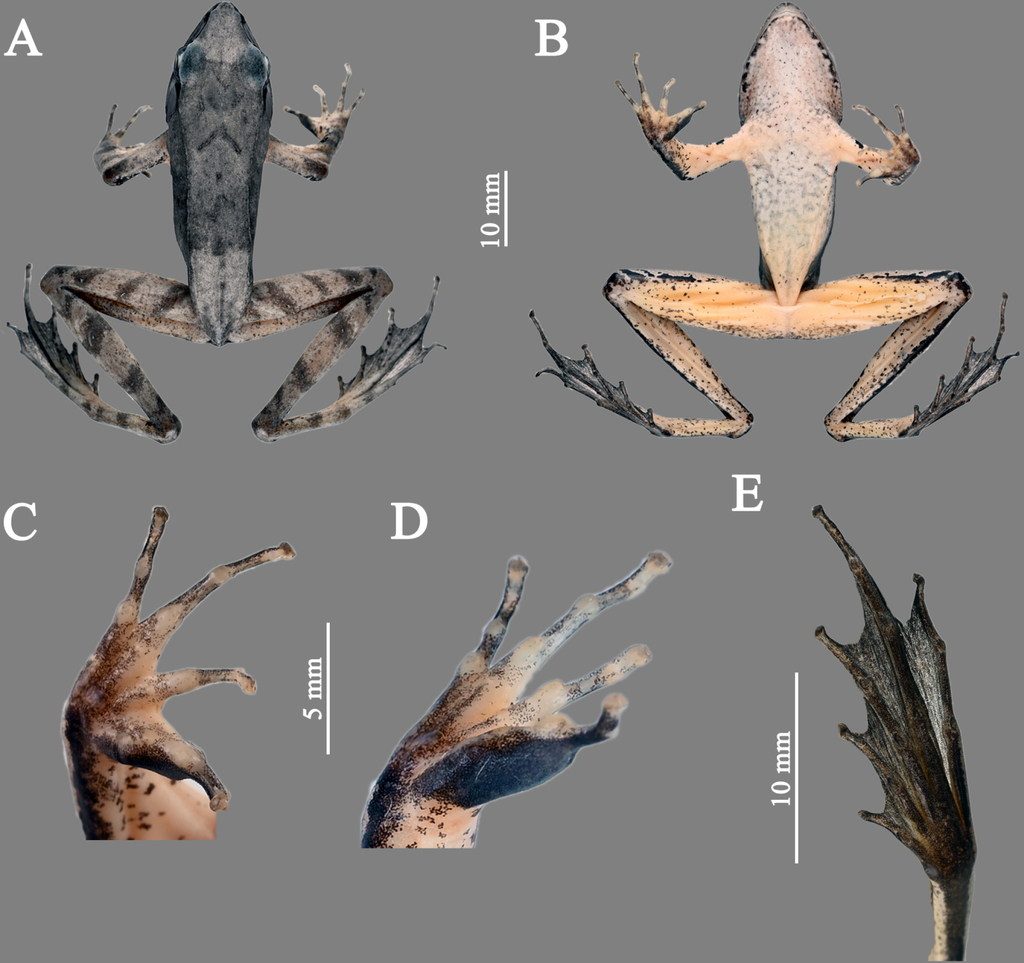
Forearms 0.19 of SVL and hand 0.24 of SVL; fingers slender, without web but with narrow fringe; tip of fingers rounded, not expanded, without lateroventral grooves; relative finger lengths II < I < IV < III; subarticular tubercles significantly prominent, rounded, formula 1, 1, 2, 2; distinct, small, rounded supernumerary tubercles below the bases of each finger; inner metacarpal tubercle indistinct, ovoid, partly covered by nuptial pad; two outer metacarpal tubercles distinctly separated, slightly larger, long elliptic; nuptial pad with tiny spines on the finger I, extending from the tip of the finger to the posterior margin of the inner metacarpal tubercle.
Hindlimbs long, tibia 0.60 of SVL and length of foot and tarsus 0.79 ratio of SVL; thigh shorter than tibia, heels overlap when hindlimbs flexed at right angles to axis of body; tibio-tarsal articulation reaching far beyond snout when hindlimb stretched forward along body; toe tips slightly expanded into small discs with lateroventral grooves present and connected at middle of front edge; inner edge of toe I and outer edge of toe V with narrow lateral fringe, relative toe lengths I < II < III < V < IV, toes webbing formula: I 0–1/2 II 0–1/2 III 1- – 1/2 IV 1- – 0 V; subarticular tubercles prominent and oval, formula 1, 1, 2, 3, 2; supernumerary tubercles absent; inner metatarsal tubercle oval and prominent, outer metatarsal tubercle rounded, indistinct.
Dorsal skin smooth, supratympanic fold absent; dorsum with a distinct chevron-shaped skin ridge; dorsolateral folds distinct, narrow, straight, extending from edge of upper eyelid to hip, not curve above tympanum; several small tubercles on flank; several tiny granules on the skin of loreal and temporal regions; ventral skin smooth, skins around cloaca with numerous flat tubercles; skin on limbs with transverse parallel bars; tarsal fold absent, and small tubercles present on the tarsus.
Coloration in life.
In life, dorsal surface overall reddish brown; a transverse stripe formed by black speckles present between the upper eyelids; loreal region dark brown, with white spots along the lower margin; a distinct triangular black patch present on temporal region, completely covering the tympanum, with its anterior margin edged by a pale border; iris bicolored, upper one-third pale yellowish brown and lower part darker, separated by a distinct horizontal boundary; pupil dark brown. Dorsal surfaces of limbs reddish brown, with several dark transverse bars; ventral surface of forelimb brown near the junction with posterior dorsal surface, gradually becoming paler toward anterior side; fingers grey; nuptial pad greyish white; toe webs dark brown to black; toe tips grey; ventral surface of tibia yellow; posterior surface of thigh orange brown. Ventral surface creamy white to pale yellow; throat and chest suffused with pale yellow.
In preservative, dorsal surface greyish brown with dark brown mottling; limbs greyish brown with dark transverse bars; loreal and temporal regions dark grey; ventral surface creamy white, with grey mottling on throat and chest; ventral surfaces of limbs pale orange to beige, scattered with dark speckles; toe webs dark grey to black; nuptial pad dark grey.
Variation.
Measurements of type series specimens are given in Table
Measurements (in mm) and body proportions of the type series of Rana hainan sp. nov. The asterisk indicates the holotype.
| Voucher ID | HNU 251008 | HNU 260411* | HNU 260412 | SYNU 900774 | HNU 250901 | HNU 260413 | HNU 260414 | HNU 260407 | HNU 260408 | HNU 260409 | ||
|---|---|---|---|---|---|---|---|---|---|---|---|---|
| Sex | Male | Male | Male | Female | Female | Female | Female | Female | Female | Female | Female | Female |
| SVL | 44.4 | 44.8 | 45.4 | 51.4 | 54.3 | 56.0 | 50.8 | 48.5 | 57.5 | 46.2 | 45.4 | 50.4 |
| HDL | 16.4 | 16.9 | 15.9 | 19.0 | 19.5 | 19.9 | 19.0 | 17.9 | 20.6 | 18.8 | 17.7 | 18.7 |
| HDW | 14.0 | 13.2 | 13.7 | 17.2 | 16.7 | 18.5 | 15.5 | 15.4 | 17.9 | 15.7 | 14.4 | 16.6 |
| SL | 6.8 | 7.3 | 6.2 | 7.4 | 7.8 | 8.9 | 7.4 | 6.7 | 8.6 | 7.4 | 7.0 | 7.3 |
| IND | 4.2 | 3.7 | 3.8 | 4.2 | 4.8 | 4.9 | 4.4 | 3.9 | 4.8 | 4.5 | 4.2 | 4.6 |
| IOD | 3.0 | 3.4 | 3.2 | 3.3 | 4.0 | 4.1 | 3.8 | 3.4 | 4.3 | 3.9 | 3.5 | 3.6 |
| UEW | 3.0 | 2.7 | 3.2 | 3.2 | 3.5 | 4.3 | 3.0 | 3.3 | 4.3 | 3.3 | 3.0 | 3.4 |
| ED | 4.7 | 4.8 | 4.9 | 5.1 | 5.3 | 5.6 | 5.3 | 5.0 | 6.2 | 4.7 | 4.7 | 5.3 |
| TYD | 3.4 | 3.9 | 3.6 | 3.9 | 3.7 | 4.4 | 3.7 | 3.5 | 3.8 | 3.5 | 3.2 | 4.0 |
| LAL | 18.1 | 19.5 | 20.1 | 21.5 | 20.5 | 23.2 | 23.8 | 21.8 | 26.1 | 20.5 | 21.8 | 22.8 |
| HAL | 11.5 | 10.8 | 11.0 | 13.0 | 12.1 | 14.2 | 11.9 | 11.6 | 14.2 | 11.8 | 12.6 | 12.4 |
| LW | 3.9 | 3.6 | 3.4 | 3.1 | 4.0 | 4.0 | 3.1 | 3.0 | 3.9 | 3.2 | 3.4 | 3.5 |
| THL | 22.7 | 24.0 | 23.9 | 28.3 | 29.6 | 32.5 | 28.1 | 25.1 | 30.2 | 26.5 | 25.6 | 27.9 |
| TL | 27.8 | 27.0 | 28.2 | 32.9 | 32.1 | 35.4 | 32.8 | 31.0 | 33.9 | 30.7 | 31.1 | 32.4 |
| TW | 7.9 | 4.3 | 4.9 | 4.1 | 5.4 | 5.7 | 5.7 | 4.2 | 6.1 | 4.2 | 4.4 | 5.4 |
| TFL | 35.7 | 35.8 | 36.4 | 40.7 | 38.5 | 45.5 | 43.2 | 37.7 | 43.0 | 37.9 | 38.2 | 41.4 |
| FL | 25.7 | 24.2 | 25.7 | 28.6 | 26.6 | 30.7 | 30.0 | 24.6 | 29.4 | 25.4 | 26.1 | 29.0 |
| HDL/SVL | 0.37 | 0.38 | 0.35 | 0.37 | 0.36 | 0.36 | 0.37 | 0.37 | 0.36 | 0.41 | 0.39 | 0.37 |
| HDW/HDL | 0.85 | 0.78 | 0.86 | 0.91 | 0.86 | 0.93 | 0.82 | 0.86 | 0.87 | 0.84 | 0.81 | 0.89 |
| SL/SVL | 0.15 | 0.16 | 0.14 | 0.14 | 0.14 | 0.16 | 0.15 | 0.14 | 0.15 | 0.16 | 0.15 | 0.14 |
| ED/HDL | 0.29 | 0.28 | 0.31 | 0.27 | 0.27 | 0.28 | 0.28 | 0.28 | 0.30 | 0.25 | 0.27 | 0.28 |
| TYD/HDL | 0.21 | 0.23 | 0.23 | 0.21 | 0.19 | 0.22 | 0.19 | 0.20 | 0.18 | 0.19 | 0.18 | 0.21 |
| TL/SVL | 0.63 | 0.60 | 0.62 | 0.64 | 0.59 | 0.63 | 0.65 | 0.64 | 0.59 | 0.66 | 0.69 | 0.64 |
| THL/SVL | 0.51 | 0.54 | 0.53 | 0.55 | 0.55 | 0.58 | 0.55 | 0.52 | 0.53 | 0.57 | 0.56 | 0.55 |
| TFL/SVL | 0.80 | 0.80 | 0.80 | 0.79 | 0.71 | 0.81 | 0.85 | 0.78 | 0.75 | 0.82 | 0.84 | 0.82 |
| FL/SVL | 0.58 | 0.54 | 0.57 | 0.56 | 0.49 | 0.55 | 0.59 | 0.51 | 0.51 | 0.55 | 0.57 | 0.58 |
| HAL/SVL | 0.26 | 0.24 | 0.24 | 0.25 | 0.22 | 0.25 | 0.23 | 0.24 | 0.25 | 0.26 | 0.28 | 0.25 |
| LAL/SVL | 0.41 | 0.44 | 0.44 | 0.42 | 0.38 | 0.41 | 0.47 | 0.45 | 0.45 | 0.44 | 0.48 | 0.45 |
Sexual dimorphism.
Breeding males possessing a grayish-white nuptial pad forming a continuous patch on finger I, extending from the tip of the finger to the posterior margin of the inner metacarpal tubercle, and densely covered with tiny hoary nuptial spines. Male with a pair of internal subgular vocal sacs.
Etymology.
The specific epithet “hainan” is a noun in apposition referring to the type locality of Hainan Province, China. The English common name “Hainan Groove-toed Frog” and formal Chinese name “海南趾沟蛙” (hǎi nán zhǐ gōu wā) are proposed.
Comparison.
Rana hainan sp. nov. is assigned to the R. johnsi group due to the presence of lateroventral grooves on the flattened tips of the toes, a distinct triangular black patch on the temporal region, and vocal sacs in males, distinguishing it from other species of the subgenus Rana.
Within the R. johnsi group, Rana hainan sp. nov. differs from R. johnsi in mean values of SL, IOD, UEW, LW, THL, TW (Table
Distribution and natural history.
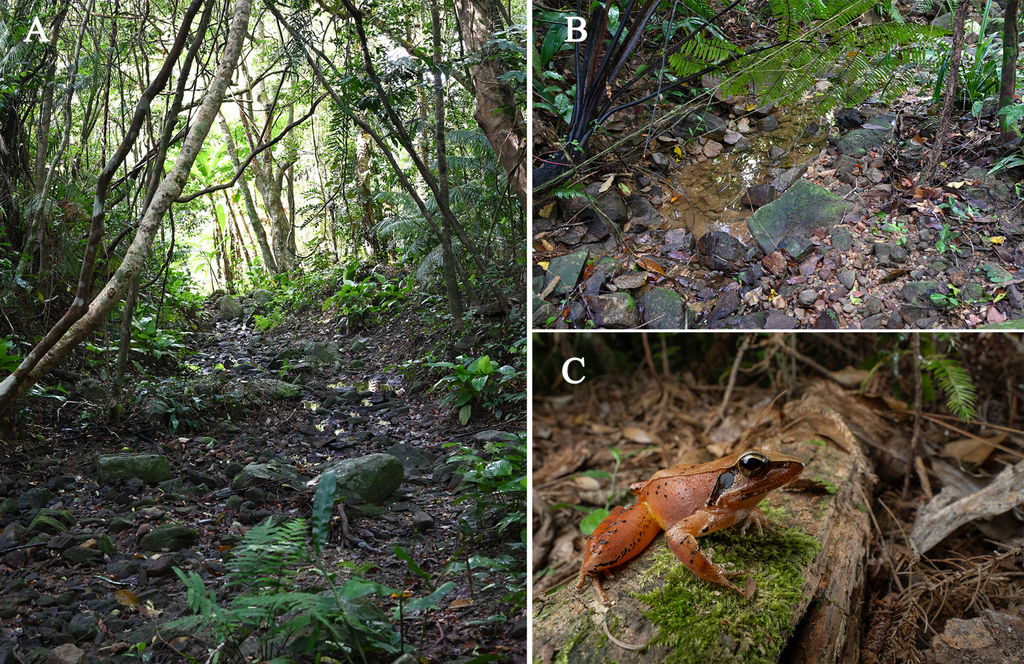
Rana hainan sp. nov. is currently known from Shangxi Provincial Nature Reserve in Wanning and the Diaoluo Mountain section of Hainan Tropical Rainforest National Park, Hainan, China. The population reported from Mt. Jianfengling, Ledong by
Rana hainan sp. nov. inhabits tropical rainforest at elevations of 350–950 m, predominantly in evergreen broadleaf forests (Fig.
Discussion
The phylogenetic relationships recovered within the Rana johnsi group reveal a clear geographic structure across southern China and Vietnam. In the reconstructed phylogeny, Rana hainan sp. nov. is clearly separated from the remaining congeners, followed by R. sangzhiensis, whereas R. johnsi and R. wuyiensis form a strongly supported sister clade (Fig.
In light of the taxonomic confusion surrounding historical Rana records from Hainan Island outlined above, our results provide new evidence for reassessing the identity of these populations. Most previous studies lack clear voucher specimens from Hainan or detailed identification information, and R. johnsi and R. nigrotympanica are morphologically similar, making misidentifications likely in the absence of systematic comparisons. Furthermore, the taxonomic status of R. nigrotympanica has long been controversial, with Fei et al. (
Acknowledgements
We are very grateful to the subject editor Luis Ceríaco and the reviewers for their constructive comments on this manuscript. This work was supported by Comprehensive Survey and Monitoring Project of Ecological Resources in Hainan Tropical Rainforest National Park (HNZC2026-057-001), the National Animal Collection Resource Center, China and the Comprehensive Herpetological Survey of Shangxi and Liulianling Nature Reserves.
References
- AmphibiaChina (2026) The database of Chinese amphibians. [accessed 25 March 2026] http://www.amphibiachina.org/
- Anisimova M, Gil M, Dufayard J-F, Dessimoz C, Gascuel O (2011) Survey of branch support methods demonstrates accuracy, power, and robustness of fast likelihood-based approximation schemes. Systematic Biology 60: 685–699. https://doi.org/10.1093/sysbio/syr041
- Boulenger GA (1920) A monograph of the South Asian, Papuan, Melanesian and Australian frogs of the genus Rana. Records of the Indian Museum 20: 1–226. https://doi.org/10.5962/bhl.title.12471
- Bourret R (1939) Notes herpétologiques sur l’Indochine française. XX. Liste des Reptiles et batraciens actuellement connus en Indochine Française. Annexe au Bulletin Général de l’Instruction Publique 1939: 49–60.
- Chan KO, Grismer LL (2022) GroupStruct: An R package for allometric size correction. Zootaxa 5124: 471–482. https://doi.org/10.11646/zootaxa.5124.4.4
- Chan KO, Grismer LL (2025) GroupStruct2: A user-friendly graphical user interface for statistical and visual support in species diagnosis. Systematic Biology: syaf090. https://doi.org/10.1093/sysbio/syaf090
- Che J, Pang J, Zhao H, Wu G, Zhao E, Zhang Y (2007) Phylogeny of Raninae (Anura: Ranidae) inferred from mitochondrial and nuclear sequences. Molecular Phylogenetics and Evolution 43: 1–13. https://doi.org/10.1016/j.ympev.2006.11.032
- Chen X, Chen Z, Jiang J, Qiao L, Lu Y, Zhou K, Zheng G, Zhai X, Liu J (2013) Molecular phylogeny and diversification of the genus Odorrana (Amphibia, Anura, Ranidae) inferred from two mitochondrial genes. Molecular Phylogenetics and Evolution 69: 1196–1202. https://doi.org/10.1016/j.ympev.2013.07.023
- Dubois A (1981) Liste des genres et sous-genres nominaux de Ranoidea (Amphibiens Anoures) du monde, avec identification de leurs espèces types; consequences nomenclaturales. Monitore Zoologico Italiano. Nuova Serie, Supplemento. Firenze 15: 225–284. https://doi.org/10.1080/03749444.1981.10736637
- Dubois A (1992) Notes sur la classification des Ranidae (Amphibiens Anoures). Bulletin Mensuel de la Société Linnéenne de Lyon 61: 305–352. https://doi.org/10.3406/linly.1992.11011
- Dubois A, Ohler A, Pyron RA (2021) New concepts and methods for phylogenetic taxonomy and nomenclature in zoology, exemplified by a new ranked cladonomy of recent amphibians (Lissamphibia). Megataxa 5: 1–738. https://doi.org/10.11646/megataxa.5.1.1
- Edgar RC (2004) MUSCLE: multiple sequence alignment with high accuracy and high throughput. Nucleic Acids Research 32: 1792–1797. https://doi.org/10.1093/nar/gkh340
- Fei L, Ye CY, Jiang JP, Xie F, Huang YZ (2005) An Illustrated Key to Chinese Amphibians. Sichuan Publishing House of Science and Technology, Chengdu. [In Chinese]
- Fei L, Hu SQ, Ye CY, Huang YZ (2009) Fauna Sinica. Amphibia (Vol. 2) Anura. Science Press, Beijing. [In Chinese]
- Fei L, Ye CY, Jiang JP (2012) Colored atlas of Chinese amphibians and their distributions. Sichuan Publishing House of Science & Technology, Chengdu. [In Chinese]
- Frost DR (2026) Amphibian Species of the World: An Online Reference. Version 6.2 [accessed 25 March 2026]. https://doi.org/10.5531/db.vz.0001
- Frost DR, Grant T, Faivovich J, Bain RH, Haas A, Haddad CFB, De Sa RO, Channing A, Wilkinson M, Donnellan SC, Raxworthy CJ, Campbell JA, Blotto BL, Moler PE, Drewes RC, Nussbaum RA, Lynch JD, Green DM, Wheeler W (2006) The amphibian tree of life. Bulletin of the American Museum of Natural History 297: 1–370. https://doi.org/10.5531/sd.sp.13
- Grismer LL, Pinto LD, Quah ESH, Anuar S, Cota M, Mcguire JA, Iskandar DT, Wood Jr PL, Grismer JL (2022) Phylogenetic and multivariate analyses of Gekko smithii Gray, 1842 recover a new species from Peninsular Malaysia and support the resurrection of G. albomaculatus (Giebel, 1861) from Sumatra. Vertebrate Zoology 72: 47–80. https://doi.org/10.3897/vz.72.e77702
- Huang X, Hsu K, Kang B, Kuo P, Tsai W, Liang C, Lin H, Wang W (2019) Population structure of Aphyocypris normalis: Phylogeography and systematics. ZooKeys 872: 77–90. https://doi.org/10.3897/zookeys.872.33105
- Huang Y, Guo X, Ho SYW, Shi H, Li J, Li J, Cai B, Wang Y (2013) Diversification and Demography of the Oriental Garden Lizard (Calotes versicolor) on Hainan Island and the Adjacent Mainland. PLOS ONE 8: e64754. https://doi.org/10.1371/journal.pone.0064754
- Inger RF (1996) Commentary on a proposed classification of the family Ranidae. Herpetologica 52: 241–246.
- Inger RF, Orlov NL, Darevsky IS (1999) Frogs of Vietnam: A report on new collections. Fieldiana Zoology 92: 1–46. https://doi.org/10.5281/zenodo.13464976
- Jiang JP, Fei L, Ye CY, Zeng XM, Zhen MQ, Xie F, Chen YY (1997) Studies on the taxonomics of species of Pseudorana and discussions of the phelogenetical relationships with its relative genera. Cultum Herpetologica Sinica 6–7: 67–74. [In Chinese]
- Kalyaanamoorthy S, Minh BQ, Wong TKF, von Haeseler A, Jermiin LS (2017) ModelFinder: Fast model selection for accurate phylogenetic estimates. Nature Methods 14: 587–589. https://doi.org/10.1038/nmeth.4285
- Lin LH, Ji X, Diong CH, Du Y, Lin CX (2010) Phylogeography and population structure of the Reevese’s Butterfly Lizard (Leiolepis reevesii) inferred from mitochondrial DNA sequences. Molecular Phylogenetics and Evolution 56: 601–607. https://doi.org/10.1016/j.ympev.2010.04.032
- Liu CC, Hu SC (1959) Preliminary report of Amphibia from southern Yunnan. Acta Zoologica Sinica 11(4): 508–538. [In Chinese]
- Liu CC, Hu SC, Fei L, Huang CC (1973) On collections of Amphibians from Hainan Island. Acta Zoologica Sinica 19(4): 385–404. [In Chinese with English abstract]
- Macey JR, Strasburg JL, Brisson JA, Vredenburg VT, Jennings M, Larson A (2001) Molecular phylogenetics of Western North American frogs of the Rana boylii species group. Molecular Phylogenetics and Evolution 19: 131–143. https://doi.org/10.1006/mpev.2000.0908
- Meyer CP, Geller JB, Paulay G (2005) Fine scale endemism on coral reefs: archipelagic differentiation in turbinid gastropods. Evolution 59: 113–125. https://doi.org/10.1111/j.0014-3820.2005.tb00899.x
- Minh BQ, Nguyen MAT, von Haeseler A (2013) Ultrafast approximation for phylogenetic bootstrap. Molecular Biology and Evolution 30: 1188–1195. https://doi.org/10.1093/molbev/mst024
- Ohler A (2007) New synonyms in specific names of frogs (Raninae) from the border regions between China, Laos and Vietnam. Alytes 25: 55–74.
- Pyron RA, Wiens JJ (2011) A large-scale phylogeny of Amphibia including over 2800 species, and a revised classification of extant frogs, salamanders, and caecilians. Molecular Phylogenetics and Evolution 61: 543–583. https://doi.org/10.1016/j.ympev.2011.06.012
- Qi S, Ngo HN, Grismer LL, Wang HT, Song HM, Zhu XY, He ZQ, Zhou ZC, Li PP, Wang JC, Wang YY (2025) Integrative taxonomic revision of the Goniurosaurus lichtenfelderi group (Squamata: Eublepharidae): Insights from morphological and molecular data. Vertebrate Zoology 75: 673–698. https://doi.org/10.3897/vz.75.e158031
- R Core Team (2024) R: A Language and Environment for Statistical Computing. R Foundation for Statistical Computing, Vienna. https://www.R-project.org/ https://doi.org/10.32614/r.manuals
- Ronquist F, Teslenko M, Van Der Mark P, Ayres DL, Darling A, Höhna S, Larget B, Liu L, Suchard MA, Huelsenbeck JP (2012) MrBayes 3.2: Efficient Bayesian phylogenetic inference and model choice across a large model space. Systematic Biology 61: 539–542. https://doi.org/10.1093/sysbio/sys029
- Shen YH (1986) A new Ranid species (Rana sangzhiensis) from Hunan. Acta Herpetologica Sinica 5(4): 290–294. [In Chinese with English abstract]
- Shi HT, Zhao EM and Wang LJ (2011) The Amphibia and Reptilia Fauna of Hainan. Science Press, Beijing. [In Chinese]
- Simon C, Frati F, Beckenbach A, Crespi B, Liu H, Flook P (1994) Evolution, weighting, and phylogenetic utility of mitochondrial gene sequences and a compilation of conserved polymerase chain reaction primers. Annals of the Entomological Society of America 87: 651–701. https://doi.org/10.1093/aesa/87.6.651
- Smith MA (1921) New or Little-known Reptiles and Batrachians from Southern Annam (Indo-China). Proceedings of the Zoological Society of London 1921: 423–440. https://doi.org/10.1111/j.1096-3642.1921.tb03271.x
- Tamura K, Stecher G, Kumar S (2021) MEGA11: Molecular Evolutionary Genetics Analysis Version 11. Molecular Biology and Evolution 38: 3022–3027. https://doi.org/10.1093/molbev/msab120
- Thorpe RS (1975) Quantitative handling of characters useful in snake systematics with particular reference to interspecific variation in the Ringed Snake, Natrix natrix (L.). Biological Journal of the Linnaean Society 7: 27–43. https://doi.org/10.1111/j.1095-8312.1975.tb00732.x
- Wan H, Lyu Z, Qi S, Zhao J, Li P, Wang Y (2020) A new species of the Rana japonica group (Anura, Ranidae, Rana) from China, with a taxonomic proposal for the R. johnsi group. ZooKeys 942: 141–158. https://doi.org/10.3897/zookeys.942.46928
- Wang C, Qian L, Zhang C, Guo W, Pan T, Wu J, Wang H, Zhang B (2017) A new species of Rana from the Dabie Mountains in eastern China (Anura, Ranidae). ZooKeys 724: 135–153. https://doi.org/10.3897/zookeys.724.19383
- Wang JC, Shi HT, Wang LJ, Xie MD, Li DJ, Zou Q (2007) Three rare amphibian and reptile animals on Diaoluoshan, Hainan. Sichuan Journal of Zoology 26(2): 354–355. [In Chinese with English abstract]
- Wiens JJ, Sukumaran J, Pyron RA, Brown RM (2009) Evolutionary and biogeographic origins of high tropical diversity in old world frogs (Ranidae). Evolution 63: 1217–1231. https://doi.org/10.1111/j.1558-5646.2009.00610.x
- Wong TKF, Ly-Trong N, Ren H, Banos H, Roger AJ, Susko E, Bielow C, De Maio N, Goldman N, Hahn MW, Huttley G, Lanfear R, Minh BQ (2025) IQ-TREE 3: Phylogenomic inference software using complex evolutionary models. Submitted. https://doi.org/10.32942/x2p62n
- Wu Y, Shi S, Zhang H, Chen W, Cai B, Hoang VC, Wu J, Wang B (2021) A new species of the genus Rana sensu lato Linnaeus, 1758 (Anura, Ranidae) from Wuyi Mountain, Fujian Province, China. ZooKeys 1065: 101–124. https://doi.org/10.3897/zookeys.1065.67005
- Xie J, Chen Y, Cai G, Cai R, Hu Z, Wang H (2023) Tree visualization by one table (tvBOT): A web application for visualizing, modifying and annotating phylogenetic trees. Nucleic Acids Research 51: W587–W592. https://doi.org/10.1093/nar/gkad359
- Yan F, Jiang K, Chen H, Fang P, Jin J, Li Y, Wang S, Murphy RW, Che J, Zhang Y (2011) Matrilineal history of the Rana longicrus species group (Rana, Ranidae, Anura) and the description of a new species from Hunan, southern China. Asian Herpetological Research 2: 61–71. https://doi.org/10.3724/SP.J.1245.2011.00061
- Yang BT, Zhou Y, Min MS, Matsui M, Dong BJ, Li PP, Fong JJ (2017) Diversity and phylogeography of Northeast Asian brown frogs allied to Rana dybowskii (Anura, Ranidae). Molecular Phylogenetics and Evolution 112: 148–157. https://doi.org/10.1016/j.ympev.2017.04.026
- Yuan Z, Zhou W, Chen X, Poyarkov Jr NA, Chen H, Jang-liaw N, Chou W, Matzke NJ, Iizuka K, Min M, Kuzmin SL, Zhang Y, Cannatella DC, Hillis DM, Che J (2016) Spatiotemporal diversification of the true frogs (Genus Rana): A historical framework for a widely studied group of model organisms. Systematic Biology 65: 824–842. https://doi.org/10.1093/sysbio/syw055
- Zhao H, Yang J, Wang C, Li P, Yuan Z (2017) A new species of the genus Rana from Henan, central China (Anura, Ranidae). ZooKeys 694: 95–108. https://doi.org/10.3897/zookeys.694.12513
- Zhou Y, Yang BT, Li PP, Min MS, Fong JJ, Dong BJ, Zhou ZY, Lu YY (2015) Molecular and morphological evidence for Rana kunyuensis as a junior synonym of Rana coreana (Anura: Ranidae). Journal of Herpetology 49: 302–307. https://doi.org/10.1670/13-111
- Zhou Y, Wang SR, Zhu HD, Li PP, Yang BT, Ma JZ (2017) Phylogeny and biogeography of south Chinese brown frogs (Ranidae, Anura). PLOS ONE 12: e0175113. https://doi.org/10.1371/journal.pone.0175113
Additional information
Conflict of interest
The authors have declared that no competing interests exist.
Ethical statement
No ethical statement was reported.
Artificial Intelligence (AI) use
The authors accept full responsibility for the content of the manuscript, including the disclosure of any use of AI.
No AI tools were used in the preparation of this manuscript.
Funding
Comprehensive Survey and Monitoring Project of Ecological Resources in Hainan Tropical Rainforest National Park (HNZC2026-057-001).
Author contributions
Conceptualization: HMS, PPL, JW, YYW, JCW, BW, SQ, HTW. Data curation: MHH, XCQ. Formal analysis: HMS. Funding acquisition: JCW. Investigation: SBZ, WW, CXL, MHH, DED. Methodology: HTW, SQ, XCQ. Supervision: JCW. Writing – original draft: HTW. Writing – review and editing: PPL, XCQ, HMS, YYW, JCW, SQ, CXL.
Author ORCIDs
H.-T. Wang https://orcid.org/0000-0002-2415-3234
M.-H. Huang https://orcid.org/0009-0002-9965-9309
H.-M. Song https://orcid.org/0009-0005-8244-1567
S. Qi https://orcid.org/0000-0002-2924-6093
W. Wang https://orcid.org/0009-0002-6437-0484
B. Wang https://orcid.org/0000-0001-6036-5579
Y.-Y. Wang https://orcid.org/0000-0003-2024-6641
P.-P. Li https://orcid.org/0000-0002-0713-5384
J.-C. Wang https://orcid.org/0000-0001-5081-2355
Data availability
All of the data that support the findings of this study are available in the main text or Supplementary Information.
Supplementary materials
Kimura 2-parameter distances (%) of the 16S gene amongst species of Rana used in this study
Data type: xlsx
Kimura 2-parameter distances (%) of the COI gene amongst species of Rana used in this study
Data type: xlsx
Kimura 2-parameter distances (%) of the cyt b gene amongst species of Rana used in this study
Data type: xlsx
Morphometric comparisons between the Rana hainan sp. nov. and its closely related species
Data type: docx